
Smarter Marketing for Introverts
What it Means, How it's Different, and Why it Works

When I was eight years old, a friend gave me a beautiful silver bracelet.
She had made it with her father, who was a silversmith, and she gave it to me to say thank you. Not for a birthday or a special occasion, but because, in her words, I had helped her feel more confident and find her place at school.
I remember feeling completely confused and a little guilty, as I didn’t think I had done anything to deserve such a thoughtful gift.
But that moment has always stayed with me.
Looking back now, I can see that moment more clearly. And how helping people recognise their value and quietly believe in themselves, has always been something I’ve done. Long before I recognised it or had language for it.
And how over the years, while my work has taken different forms, this idea has always been a central theme. From my roles in marketing and branding, to corporate communication and consulting, to business and leadership communication training and coaching it was always present. Today, I’ve named this approach: Value Whispering, or here simply as smarter marketing for introverts.
On the surface, it might look like my work has evolved over the years. In retrospect it has barely changed.
Because at its heart, it has always been about the same thing:
Helping people (and companies) see, appreciate and believe in their true value … before finding a way to express it naturally, so others can see it too.
Most people don’t struggle with value. They struggle with seeing it clearly enough to stand behind it and put words to it.
Smarter marketing for introverts
I think that’s why I find the whole conversation around marketing so interesting.
Because what so many people see as ‘marketing’ to me are just tactics and not what I would call marketing at all.
Because it’s not a single activity, it’s a flow.
Marketing isn’t what you do to get clients.
It’s how clients experience you before they choose you.
Therefore, marketing done well is an intentional journey you create that helps the right people to find you and, step-by-step, know, like and trust you, to the point where they believe you are the perfect person to serve them (or not).
Each step in that journey should be created to help people think, feel and act a particular way. That requires deep thinking and care. And when that’s missing, even the best tactics feel random and rarely lead anywhere meaningful.
The thing to know here is that all of this is something that thoughtful, capable, experienced experts and business owners, especially those who are more introverted, naturally excel at - once they have the right framework and support to create this flow.
But without this understanding of marketing, these same caring, brilliant people struggle when it comes to attracting clients.
They start to question themselves.
They overthink what to say.
They hesitate to put themselves forward.
Or they try to follow advice that, on paper, makes sense… but in practice feels heavy, or forced, or just not quite right.
It often sounds like this:
“I know I should be doing more, but I just can’t seem to make it work.”
And for a long time, I think many people quietly assume that means they are the problem.
That they’re not confident enough.
Not consistent enough.
Not cut out for business in the way others seem to be.
But the more I’ve seen this, the more I’ve come to a different conclusion.
It’s not that they’re doing it wrong.
It’s that they’re trying to do it in a way that doesn’t fit. And anything that doesn’t fit will always feel harder than it needs to.
Quiet marketing is invisible
Most of the marketing we see is, quite naturally, the loudest kind.
The people posting every day.
The bold claims and flashy videos.
The high energy launches.
And there’s nothing wrong with that. If it works well for you and your personality, wonderful.
But because this is the kind of marketing we see most often, it quietly shapes what we believe marketing is supposed to look like. It starts to feel like this is the way, perhaps even the only way.
Visibility skews perception.
We assume what we see most is what works best.
We see something similar when it comes to sales.
When people hear the word ‘sales’, they often picture the loud, pushy car salesman from years gone by. That slightly uncomfortable, high-pressure experience.
But when sales is done well, we don’t call it sales at all.
We talk about how someone really listened.
How they asked thoughtful questions.
How they took the time to understand what we needed, and guided us towards the right decision.
Good sales rarely feels like selling.
It feels like being seen, understood and valued.
And because we describe it so differently, we don’t always connect those experiences back to ‘sales’. So our old assumption stays firmly in place.
It’s the same with marketing.
If the only version you see is loud and highly visible, it’s easy to assume that’s what’s required.
So if your natural way of working is quieter, more thoughtful, more relationship-led, it can leave you feeling like you’re constantly slightly out of step. Like you’re either not doing enough, not doing it properly, or that you need a personality transplant to succeed.
What we don’t see as easily are all the businesses growing in a different way.
The ones built on clarity rather than noise, trust rather than urgency, depth rather than constant visibility.
Because these businesses don’t spread their marketing wide.
They use an approach that resonates deeper with the right people.
They’re there. They’re just not everywhere.
Which is often why they are also the ones quietly building the most trusted businesses.
But because we don’t see them as often, we don’t always realise that those approaches are available to us and can be highly effective.
Value over Volume
I think this is where the idea of smarter marketing for introverts really comes from.
Not as a label, but as an invitation to ask:
”What would marketing look like if it actually worked with me?”
“What if marketing started with how you naturally think, communicate and build relationships, rather than something to layer on top?”
For me, it always comes back to value.
Not in the abstract sense, but in a very real, grounded way.
Can you see the value in what you do?
Not just intellectually, but clearly enough that you can describe it in a way that someone else immediately understands why it matters. Because until you can see and articulate it clearly, you’ll always feel like you have to work hard to prove it.
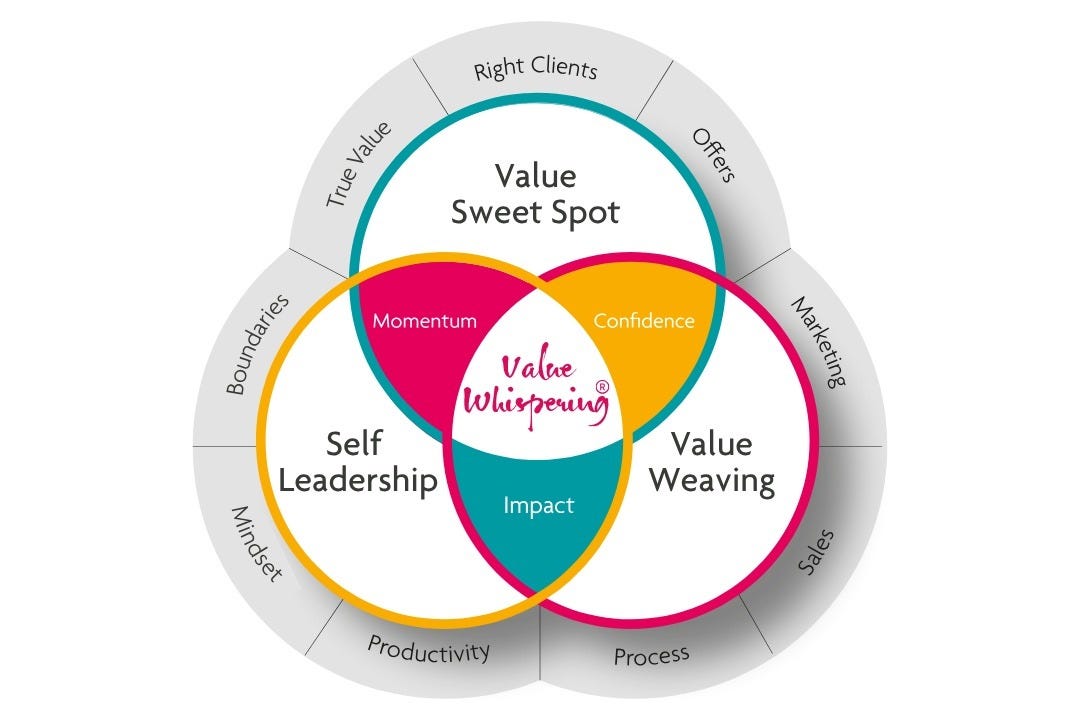
This is where I often talk about your Value Sweet Spot. And why I have made it the first step in my three-part Value Whispering methodology.
That place where what you’re naturally brilliant at, what you care about, and what your ideal clients genuinely need… all overlap.
When you’re working from there, something shifts.
You’re no longer trying to ‘position’ yourself in a way that sounds right.
You’re expressing something that already is right.
And that makes everything that follows feel lighter and more natural. It’s also easier to manage in a way that works for your personality and lifestyle (I’ll come back to this idea in a moment).
Because from there, your marketing stops being something separate that you have to “do”.
It becomes something you begin to weave into how you already work.
Into your conversations and how you explain things.
Into your offers and the experience and transformation you create, and
Into the way you show up for and guide your prospects and clients.
This is what I think of as Value Weaving.
Not adding more on top, but allowing your value to show up more clearly, more intentionally, and more consistently, in everything you’re already doing.
It’s not about doing more marketing. It’s about making what you already do more visible, more intentional, and easier to understand.
And when that happens, people don’t just notice you more.
They understand and connect with you more quickly. Because clarity shortens the distance between you and the right client.
Value Weaving over Marketing
Value Weaving changes how you think about client attraction and growth.
There’s less pressure to be everywhere, all the time, because you’re not trying to capture attention from anyone who might be listening.
You’re much more discerning. You focus your energy on finding and speaking to the people who are most likely to recognise themselves in your work and value your approach to solving their problems.
Value Weaving also tends to be more sustainable, and perfect for:
Attracting better-fit clients.
Developing stronger, more meaningful relationships.
Engaging in work that feel energising, rather than forced or demanding.
But for this to work, there’s another piece that matters just as much.
And that’s how you lead yourself within your business.
Because even the most aligned strategy will start to feel heavy if it asks too much of you, or pulls you in directions that don’t suit you.
Sustainable success isn’t built through discipline.
It’s built through alignment.
Being Self-Full for Sustainable Success
The third part of the Value Whispering methodology ensures that success becomes sustainable and enjoyable.
It’s all about developing the right mindset and beliefs, and managing your time, energy and environment, so you consciously set yourself up for repeatable success.
This is where boundaries become so important.
Not just in the obvious sense of saying no to clients or opportunities that aren’t right, but in how you design your days, your energy, and your focus.
What do you say yes to?
What do you protect?
What do you allow to take up your time and attention?
Where can you afford to be flexible?
For many people, especially those who are thoughtful, generous, and deeply invested in their work, this is where things can quietly become overwhelming.
And if you’re someone who is neurodivergent like me, this can be even more true.
Traditional advice around productivity and consistency often assumes a very linear way of working.
But in reality, many of us work best in a much more dynamic way.
When something genuinely interests you, you can focus deeply, move quickly, and produce incredible work.
When it doesn’t, everything feels harder than it should. And no amount of willpower fixes a system that doesn’t fit you.
So rather than trying to force yourself into a system that doesn’t fit, the questions become:
How do I build this in a way that supports how I naturally work?
How can I build novelty and interest into my activities in a practical way?
What are the conditions that support my success?
Because that’s what allows you to stay motivated and consistent without burning out.
When Marketing Becomes Meaningful
When all of this comes together, something quite subtle but powerful happens.
Your marketing starts to feel less like ‘marketing’ and more like a natural extension of who you are and how you help.
Effective marketing feels like an honest reflection of how you already think, work and help. That’s how it attracts the right people, those you resonate with and value what you represent.
It feels more like sharing ideas, having meaningful conversations, helping people see things differently, and offering clarity where there was complexity or confusion.
In other words, it starts to feel like a natural extension of the work you already do.
And, maybe like me you’ll start to see how the work you do now, isn’t so different from how you showed up for your friends back in junior school all those years ago ; )
So if I could leave you with one final thought it’s this:
You don’t need a louder strategy.
You need a truer one.
And if finding that truer strategy is something you need help with right now, I’m here to support you. You can book a call to discuss how with me here.
Value Whispering Book
Get the First Chapter Free
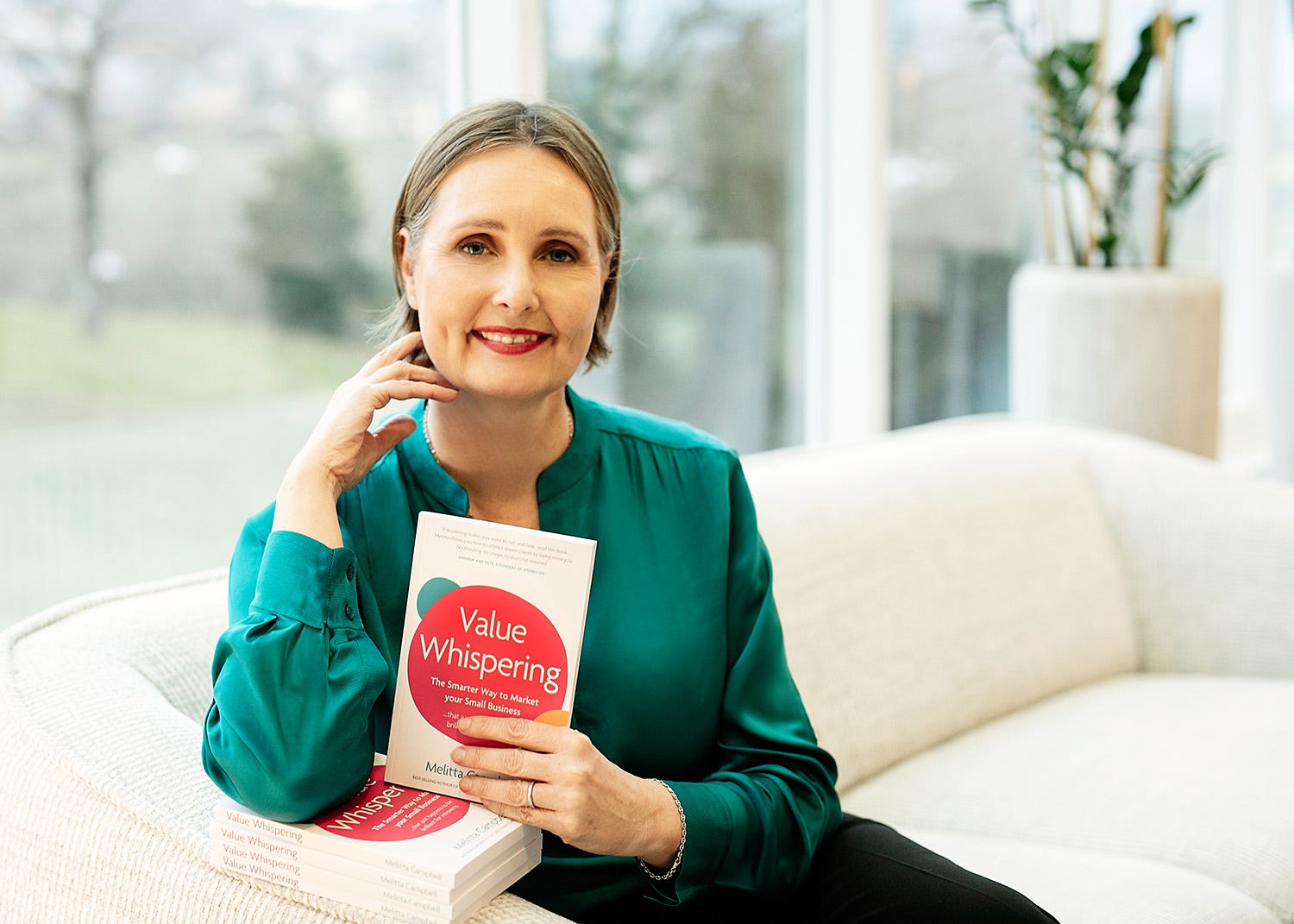
If this way of thinking about marketing resonates with you, and you’d like to explore it more deeply, you can download first chapter of my book, Value Whispering: The Smarter Way to Market Your Business for free here.
This chapter will help you start to see your value more clearly, and give you full permission to start marketing your business in a way that feels natural and true to you, and attracts the right clients.
You can read it here:
www.melittacampbell.com/chapter
Paid Subscribers: Go to the tab ‘Resources for Paid Subscribers’ at the top of this page to download your a full digital copy of the book instantly.
Thanks for sharing this Rick 😊